

 Back
to
all
Back
to
all

Wildix’s inaugural press and analyst event was set against a backdrop of contradiction.
Here’s an established 20-year-old vendor with 1.2 million users, one of just a handful featured in the Gartner UCaaS Magic Quadrant, yet also still, in some ways, needing to introduce itself to the world.
For that reason, the Venice event saw Wildix host a small group of journalists and analysts.
Its products (all built on a common platform) don’t necessarily fit neatly into the buckets we like to place vendors in, which is by no means a criticism.
x-bees, for example, functions perfectly well as a collaboration platform but also has sales intelligence and contact centre-light features.
Similarly, x-hoppers, at its core, connects colleagues but with an AI-powered twist directed squarely at the retail sector.
Here are Cavell’s top takeaways from the event.
CEO Steve Osler on verticalisation over consolidation
Steve Osler opened the event by outlining Wildix’s strategic direction over its 20-year journey. The company was founded in Trento, Italy, before expanding across Europe and into the US.
Osler positioned Wildix deliberately outside the mainstream UCaaS market, where major players like Microsoft Teams and Zoom set pricing and features that others follow. Wildix has chosen to go vertical through its channel partners rather than the mass market.
The origin story reveals much about this approach. In 2001, Osler worked as a system integrator importing early VoIP contact centre solutions from the US. The products were so problematic that his brother (who was interning at the same company) ended up fixing the bugs. This became the core of a solution that could replace the expensive American products, later being spun off as Wildix in 2005.
The channel choice was pragmatic rather than philosophical. In Italy and Europe at the time, the majority of the market was indirect, particularly in the SMB space. With no money for direct sales, the channel route was simply the best route forward, and Wildix remains 100% channel focused.
The company bootstrapped for 17 years, became profitable in 2014 and moved to Estonia (described as Europe’s Silicon Valley with favourable tax treatment for reinvestment) a few years later. A private equity investment arrived a couple of years ago to accelerate growth.
Osler explained that Europe’s fragmentation across languages and markets forced adaptation. France came first in 2007 after requests from French resellers, followed by Germany and other European locations. Each new market required adjustment, which made the eventual US arrival in 2017 a smoother transition than US companies often have when moving into Europe.
The target market has always been SMB. Enterprise was limited in Italy, and SMB aligned better with channel partners who are typically small and medium system integrators operating locally within a 100-mile radius. These partners already knew their customers through existing relationships in areas like printing services or video security. They could respond in business minutes rather than the business days typical of larger vendors.
On company culture, Osler rejected the conventional work-life balance framing. He argued we have only one life, and problems at home affect work performance and vice versa. Wildix, therefore, lets people work from wherever they want and whenever they want, with the company measuring output rather than hours. This approach yields better results and more sincere communication with less friction, Osler said, noting the contradiction of vendors producing collaboration tools whilst forcing employees back to the office. The company employs 360 people under this flexible model.
Osler closed by saying that Wildix’s aim is not to become a mass market vendor. Microsoft, Zoom and others already occupy that space. Instead, the focus remains on communication value and helping customers achieve the best return rather than chasing user numbers.
Product positioning: Three products serving different needs
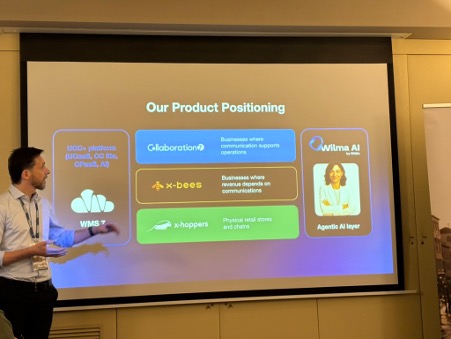
Wildix structures its offering around three distinct products built on a common platform (WMS7). This architecture allows the same underlying capabilities to be packaged differently for specific use cases – with a particular focus on certain verticals.
Cavell research shows that around 90% of providers have marketing collateral for specific verticals, but just 46% have tailored their products to a vertical, and just 27% have dedicated verticalised teams. Wildix looks to integrate deep in several chosen verticals, particularly healthcare and retail.
Cavell’s Channel Insights platform tracks 9,274 partners focused on healthcare, with 5,016 focusing on retail and ecommerce.
- Find out more about Channel Insights here
Wildix’s Collaboration 7 targets manufacturers, healthcare providers and similar organisations where operations matter more than constant customer communication. These companies need to connect offices to production floors and remote teams. They may get an order, build it and deliver it without intensive ongoing customer interaction. The product addresses companies migrating from legacy PBX systems that are approaching end of life. It offers advanced capabilities (including AI agents and multi-channel communication) whilst preserving valued features like integration with legacy systems and hybrid deployment options.
The product serves companies where the main priority is improving operations rather than revenue generation through constant customer dialogue. A case study presented was King Edward’s Hospital in London, a private maternity hospital where members of the royal family have been born. The hospital required high survivability given the critical nature of healthcare communication. Wildix deployed a hybrid solution combining cloud PBX with local hardware to ensure zero downtime if internet connectivity failed. The Georgian building’s thick stone walls created signal challenges, which were addressed using DECT phone repeaters and base stations. The deployment included wipe-clean handsets for clinical use and emergency alert buttons that send location information to nurse groups.
x-bees serves companies where communication directly drives revenue. This includes training providers, support services, consultancies, financial services and SaaS vendors. The differentiator here is sales intelligence powered by AI analysis of calls, chats and meetings. The platform includes deep Salesforce integration that embeds CRM context directly into communication flows. AI agents can log information into Salesforce, create opportunities or close cases without human intervention. The system analyses sentiment across entire conversations and provides actionable insights on deal progression and competitor mentions.
The Salesforce integration embeds the CRM inside x-bees rather than the other way round. When agents receive calls or chats, they immediately see connected opportunities, cases and tasks without switching applications. AI agents can log custom objects into Salesforce, including details like whether the budget was discussed or competitors were mentioned. This data can then drive Salesforce dashboards and trend analysis.
Sales intelligence provides both macro-level dashboards showing patterns across all customer interactions and detailed views of individual conversations with sentiment analysis, transcription and translation. Users can ask specific questions about recorded calls and receive AI-generated analysis within 30-40 seconds.
The migration path from Collaboration 7 to X-Bees is straightforward because both products share the same underlying platform, so companies can change their licence type to gain access to additional capabilities.
x-hoppers addresses retail store operations. The solution centres on push-to-talk headsets but extends far beyond simple team communication. Store associates can access AI assistants directly in their ear to answer questions about inventory, policies or procedures without needing a screen. QR codes placed throughout stores allow customers to request assistance, generating notifications that route to the appropriate specialist with location information. The system integrates with inventory management (such as MOOS for shelf monitoring) to trigger automatic replenishment alerts.
x-hoppers CRO Alberto Benigno explained that the circa 400 million retail workers globally remain underserved by technology, while some 70% of frontline teams lack real-time information and communication tools. Retailers invest heavily in understanding customer behaviour but have a blind spot between store entry and checkout. x-hoppers addresses this gap whilst tackling high staff turnover through faster onboarding and better-equipped junior staff.
The solution tracks productivity through QR code interactions and point-of-sale correlation. In airport and train station retail deployments, the system generated an average of 67 customer assistance requests per store monthly, translating to £3,300 in additional pipeline opportunity per location. By correlating QR code scans with subsequent purchases, Wildix can demonstrate which store associates are most effective at converting browsing customers into buyers.
One example involved a DIY company in Spain that struggled with financing product sales. Their revenue from financing was the lowest among competitors because store associates weren’t equipped to push financing options. Wildix uploaded the company’s financing terms and conditions into the AI. Store associates can now ask about financing policies for specific products and receive immediate answers, enabling them to make more effective financing offers to customers.
RoboReception represents an additional vertical solution developed in partnership with Focus Group and Dr Grant McAree, a dentist with 25 years of practice. McAree identified reception as a persistent bottleneck in healthcare, with one in three calls to UK dental practices going unanswered. That lost revenue became the difference between business success and failure.
RoboReception uses AI voice agents integrated with Wildix infrastructure to handle appointment bookings, rescheduling and common queries. The solution was deployed across 65 clinics within six months of launch in May 2024 (with numbers approaching 100 by the time of the Venice event). It handled over 70,000 calls with zero missed calls and 96% of inquiries resolved without human intervention. Five hundred new patients booked appointments across those locations in the first six months.
McAree spent a year working with live agents before discovering Wildix and Focus Group could provide the missing technical infrastructure. The system uses flows built from 150,000 previous calls to understand what patients ask before they actually ask it. Live agents now monitor the AI responses and refine flows rather than handling routine calls themselves.
The AI agents use natural voices (including cloned receptionist voices) to ensure elderly patients interact naturally with the system. Only 4% of callers explicitly request a transfer to a human. McAree emphasised repeatedly that the goal is not staff replacement but preservation of humanity through increased efficiency. Reception teams gain time for face-to-face contact with patients who genuinely need it. The company has not eliminated any staff positions.
The solution is expanding into GP surgeries in the UK, with five practices already interested in trials. Legal services represent another target vertical using the same flow-building approach. Geographic expansion includes Australia, Slovenia, Ireland and Wales (which requires Welsh language transcription for healthcare providers).
Wildix’s Wilma AI brand powers all three Wildix products (plus RoboReception). Wilma provides transcription, summarisation, sentiment analysis and conversational agents across voice, chat and WhatsApp channels. The AI is available in all products with varying levels of capability depending on the use case.
Channel strategy: Partners own the customer
Jason Uslan, Chief Commercial Officer, described Wildix as 100% channel with partners selling alongside the vendor rather than merely referring leads. This differentiates Wildix in a market where partners increasingly find their margins squeezed and their customer ownership eroded as vendors take over the sales cycle.
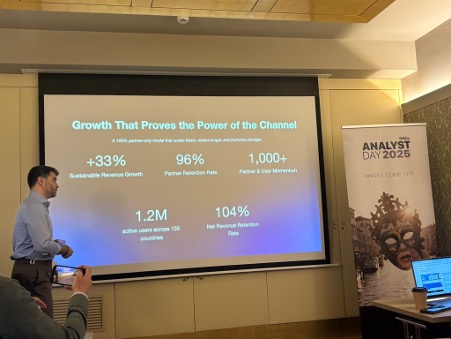
The SMB market represents over 90% of businesses, yet many solutions are built for enterprise. SMB customers need custom solutions tailored to their specific needs rather than being forced into option A, B or C. Wildix enables partners to have these conversations because the platform supports flexibility down to individual user level. Partners own the entire relationship, including billing, pricing, deployment and support. Wildix provides wraparound resources (sales engineers, solution architects, technical training) to help partners win.
The partner network exceeds 1,000 active partners globally. These are primarily MSPs, although the company also works with system integrators and other channel types. Partners invest in Wildix and Wildix invests back in them through extensive training programmes, including sales academy, technical certification and ongoing product education.
Uslan addressed the complexity of supporting diverse partner capabilities. Not all partners can handle billing or implementation. For this reason, Wildix is piloting an agency model (starting in the UK) where the company handles back-office functions whilst partners retain pricing control and customer ownership.
Partners purchase licences at a fixed price and set their own end-customer pricing, in contrast with agency models. Wildix says this means its partners typically achieve greater margins. The cost structure is flat and based on monthly licence fees for software and hardware, with no separate maintenance fees.
The single-tenant architecture means each customer gets their own PBX instance rather than sharing a multi-tenant platform. Uslan argued this provides better security by design.
Partner enablement happens through several mechanisms. When partners join Wildix, they receive extensive onboarding to ensure they can confidently speak to customers. This is positioned as a long-term relationship rather than a lead referral arrangement. Additional training covers sales methodology to help partners transition from selling products to selling solutions. Technical training ensures partners can deploy and support the platform. Online learning resources provide continuous education as the product evolves.
Partners must complete certification before they can sell, although Wildix may work with partners on real-world opportunities during the training process to provide mentorship and practical experience.
Sales engineers work daily with partners to aggregate feedback and identify trends across the partner base. This prevents roadmap distortion from individual partner requests. When multiple partners report similar needs, Wildix can act quickly. The goal is to balance customer success with business viability, avoiding wasted development on features that serve only one customer.
The go-to-market motion focuses on co-execution. Partners register opportunities (rather than placing orders), and Wildix sales teams sell alongside them rather than taking over. This side-by-side approach increases average deal size, shortens sales cycles and enables faster growth, Wildix said. Local intelligence wins because partners know their customers and markets intimately. They can customise solutions in ways that enterprise-focused vendors cannot match.
Growth metrics demonstrate the model’s effectiveness. Wildix reported 33% year-over-year growth with a net revenue retention rate of 107%.
The company entered the US market in 2017, starting in Columbus, Ohio. The US operation now covers three regions (East, Central and West) plus Canada, Central and South America.
Verticalisation as differentiation
The common thread throughout the event was verticalisation through channel expertise. Wildix does not attempt to be all things to all customers; instead, it provides partners with powerful tools that can be configured for specific industries and use cases.
This shows most clearly in X-hoppers and RoboReception, which address precise pain points in retail and healthcare, respectively. But the same principle applies to Collaboration 7 and X-Bees. The former serves operational communication needs in manufacturing and similar sectors. The latter focuses on revenue-generating communication in sales-driven organisations.
The platform architecture enables this approach. All capabilities exist in the core WMS7 layer but are exposed differently depending on which product a customer uses. A retail customer using X-hoppers gets access to features specific to store operations (like IoT device integration and QR code-triggered notifications) that would be irrelevant to a manufacturer using Collaboration 7.
The channel strategy reinforces verticalisation. Partners bring deep knowledge of their local markets and customer verticals. A partner working with dental practices understands the reception bottleneck that RoboReception solves. A partner serving retailers knows the productivity challenges that X-hoppers addresses. Wildix provides the technology platform and support resources, whilst partners deliver the vertical expertise and customisation.
This contrasts with the consolidation approach of larger vendors who acquire companies to broaden their portfolio and then attempt to create a unified platform. Wildix built a unified platform first and then verticalised through deliberate product packaging and channel enablement.
Whether this strategy allows Wildix to scale beyond its current base of 1.2 million users remains to be seen. The company is growing at 33% annually with strong unit economics (given the wholesale model and partner-led sales approach). But competing against Microsoft Teams, Google, and other mass-market platforms requires a fundamentally different approach.
Wildix appears comfortable with that choice. As Osler stated, the company is not trying to become a mass market vendor. The focus remains on delivering superior results for the underserved SMB segment through partners who can provide the local intelligence and customisation that large vendors cannot match.
The Venice event served its purpose of introducing an established but relatively unknown vendor to a broader audience. Whether Wildix can maintain its growth trajectory whilst staying true to its channel-first, verticalisation strategy will be worth watching over the coming years.