


 Back
to
all
Back
to
all
What are Voice AI Agents?
This question is regularly posed to Cavell by our CCaaS customers, financial analysts, and investors who want to understand the development of this new area of technology and the implications for the CCaaS space.
This is part of a two part blog series, breaking down the AI Voice Agent landscape and then analysing the likely impact of that on the CCaaS market. Part 1 is going to break down the AI Voice agent market, and part 2 coming out next week will dive into the CCaaS impact.
Let’s start by clearly defining what Cavell views as the different terms and players in the space.
Proper definitions
- Defining AI Voice Agents
- A voice-powered system that autonomously answers phone calls or makes proactive calls, understands natural language input in real time, and executes multi-step tasks without human handoff.
- What is not an AI Voice agent
- IVR Systems (Interactive Voice Response)
- Systems that only route based on pre-set phrases (e.g. “Say 1 for sales”) or require structured menus do not qualify.
- Systems that recognize a single command given in a specific format but cannot manage multi-turn conversations or clarify ambiguous input.
- Systems without autonomous execution
- If the system only collects intent and hands off to a human for execution, it’s not an AI agent. It’s a voice-based form.=
- Answer-only Systems
- Tools that only play a greeting, record voicemail, or send SMS confirmations without transactional capability are not AI agents.
- IVR Systems (Interactive Voice Response)
Tiers of AI Voice Agent Company
-
- Voice AI Vertical Vendor
- Small companies using basic forms of AI (typically LLMs for intent recognition) to deliver routine voice-based automation for small businesses.
- Often package third-party AI or off-the-shelf products, integrate with vertical-specific tools (e.g., CRMs or booking systems), and automate standard tasks such as scheduling or call routing.
- Example companies: Loman.ai, Ringable
- Voice AI Infrastructure Vendor
- Companies that design core Voice AI technologies (ASR, TTS, NLU, diarization, etc.) and sell them as APIs, SDKs, or platforms to enable others to build voice experiences.
- May integrate or fine-tune third-party technologies, but typically build custom components or offer proprietary enhancements that create meaningful differentiation from base models.
- These vendors often serve developers, platforms, or OEMs and usually possess deep ML/voice expertise or IP that would be difficult for others to replicate.
- Example companies: Deepgram, SoundHound
- Horizontal Voice AI
- Companies that offer broader, cross-industry voice AI platforms combining automation with workflow orchestration, integration into business tools (e.g., CRMs), and analytics.
- A key feature is that voice automation is not isolated—it’s embedded into business processes and tailored to various enterprise contexts.
- These platforms often support complex dialogue handling, fallback logic, and agent-like behaviours across verticals.
- Example companies: Cognigy, PolyAI
- CCaaS/Telco Voice AI
- Voice AI solutions developed by CCaaS or CPaaS vendors, embedded across the broader communications stack.
- These systems may power self-service voice bots but also support routing decisions, agent assist, real-time analytics, and sentiment detection as part of an integrated CX platform.
- A defining trait is that Voice AI is not the product, but a feature of a much larger ecosystem of customer engagement tools.
- Example companies: NICE Enlighten, Genesys AI, Twilio Voice Intelligence
- Voice AI Vertical Vendor
Will Voice AI Agents replace humans in the contact center?
If you believe the headlines, human contact center agents are about to be extinct, replaced by tireless AI voices handling every call flawlessly. Investors are asking if there’s even a future for contact centers at all and we’re seeing the emergence of a multitude of new companies selling AI voice agents across multiple verticals as well as vendors launching new AI functionality every week.
Cavell has researched over 180 emerging AI voice agent companies and tying this to our latest CCaaS market forecasts and interviews with over 45 contact center vendors over the last year based on this, we’ve put together this in-depth analysis of the potential and the risks within the growth of voice AI. By the end of this article, you will understand what they are, and aren’t going to do to the contact center space.
The Explosion of Voice AI Startups
Before writing this article, Cavell decided to identify as many ‘Voice AI’ companies as possible. Based on this research, we found over 180 companies, ranging from a tier 1 small company selling vertical-specific voice bots into a single region/vertical to companies building and providing custom Voice AI tools to some of the world’s largest companies.
What verticals are they going after?
Voice AI is targeting almost every vertical, but the primary ones that Cavell has tracked an explosion of startups in are:
- Healthcare
- Use Cases
- Appointment booking
- Prescription reminders
- Pre-visit screening/questionnaire
- Patient education
- Compliance tracking and recording
- Incoming call triage and prioritisation
- Home services
- Use Cases
- Appointment booking
- 24-hour emergency support
- Common issue diagnosis and FAQ answering
- Integration with key vertical technologies
- Use Cases
- Restaurants
- Use Cases
- Out of hours bookings
- FAQ and Allergy information provision
- Drive-through operation
- Use Cases
- Recruitment
- Use Cases
- Candidate screening
- Automated interviews
- Candidate rating and sorting
- Use Cases
- Automotive Dealerships
- Use Cases
- Appointment booking
- Out of hours bookings
- FAQ information provision
- Use Cases
- Insurance/Legal
- Use Cases
- Claim Processing
- FAQ information provision
- Out of hours/emergency support
- Incoming call triage and prioritisation
- Use Cases
- Finance
- Use Cases
- Account details and basic changes
- Bill payments and transfers
- Loan status and applications
- Appointment scheduling
- Card activation and blocking
- Use Cases
- Broader Customer Service
- Use Cases
- AI receptionists
- Smart routing
- Custom workflows and tasks based on CX needs.
- Use Cases
- Use Cases
Is vertical differentiation the key to success?
Yes (for now).
Today, vertical specialisation is often the only thing differentiating small Voice AI vendors, but this edge is shallow and likely temporary.
But while the language and regulatory landscape may vary across industries, the core use cases are nearly identical: appointment scheduling, FAQ responses, after-hours handling, and account detail updates. These use cases were consistent across every vertical surveyed.
This suggests that vertical differentiation is more go-to-market than product-based. As LLMs become better at handling vertical-specific language and open-source models mature, this shallow edge will erode quickly.
Larger horizontal players, especially those with workflow engines and omnichannel presence, will soon deploy vertically tuned solutions at scale, using their existing customer base and distribution channels.
So the question is: Do we need a specialised “home services Voice AI”, or do we just need a well-designed Voice AI that includes a home services module?
In short, Many current Voice AI vendors are only differentiated by the vertical they operate in, and that moat is already shrinking.
Does this also apply to mid-to-large-sized voice AI players?
This does also apply to some of the mid-to-large sized players as well. When we reviewed these companies (many of whom had received more funding). We found that some of the same problems apply.
So in general we can define a framework for strong vs weak voice AI players, in terms of how defensive they are and their long term viability.
What does ‘good’ look like for Voice AI companies?
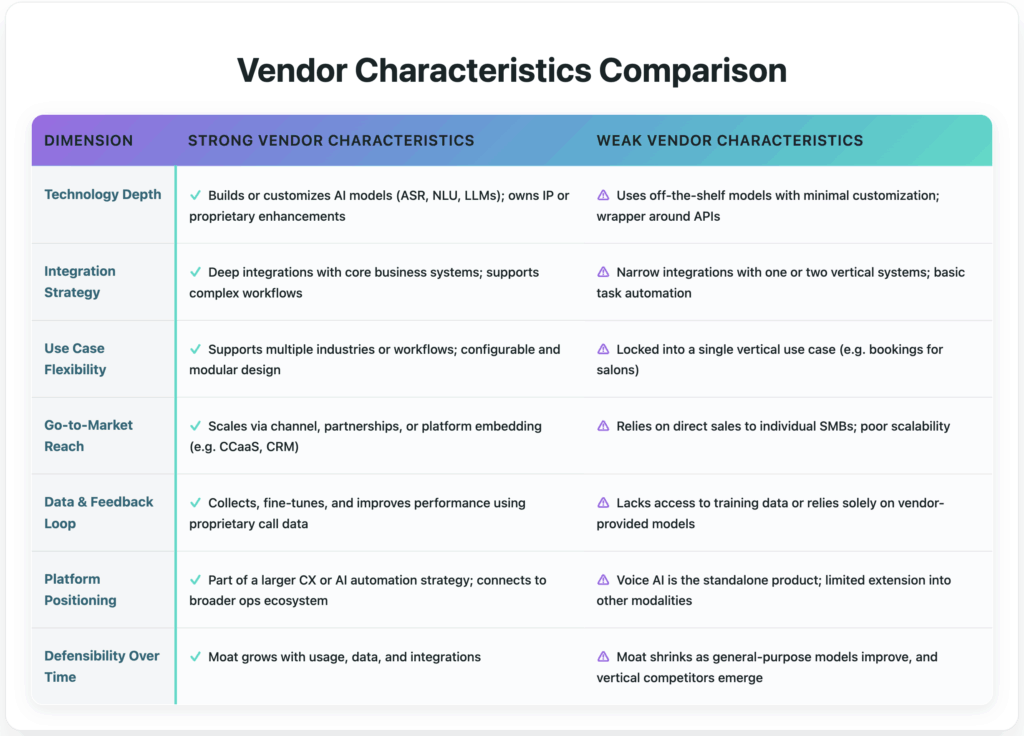
The reality is that many companies that match these ‘weak’ characteristics will either be acquired when they are small to plug a vertical gap in a larger provider, or will become less relevant when their use case is fully developed at that larger provider.
For the mid-market players, they need to work to:
- Evolve into horizontal orchestration or agent platforms, or
- Build proprietary tech and data loops, or
- Get acquired before their vertical wedge disappears
However, it is also worth noting that the larger companies that have received significant funding, are already doing this. So, the window to be the next hot Voice AI startup is rapidly closing. Unless you can make some seriously innovative new technology.
Many of the weaker companies will not survive.
How much funding are they getting?
I have mentioned funding a few times so far, so let’s break down exactly what is happening with funding where there is public data available.
Of the 180 companies evaluated, 37% of them were still unfunded, 30% had received Seed/Accelerator funding, 9% had reached Series A, 2% had reached Series B, 4% had reached Series C+ and 1 company had conducted an IPO (SoundHound).
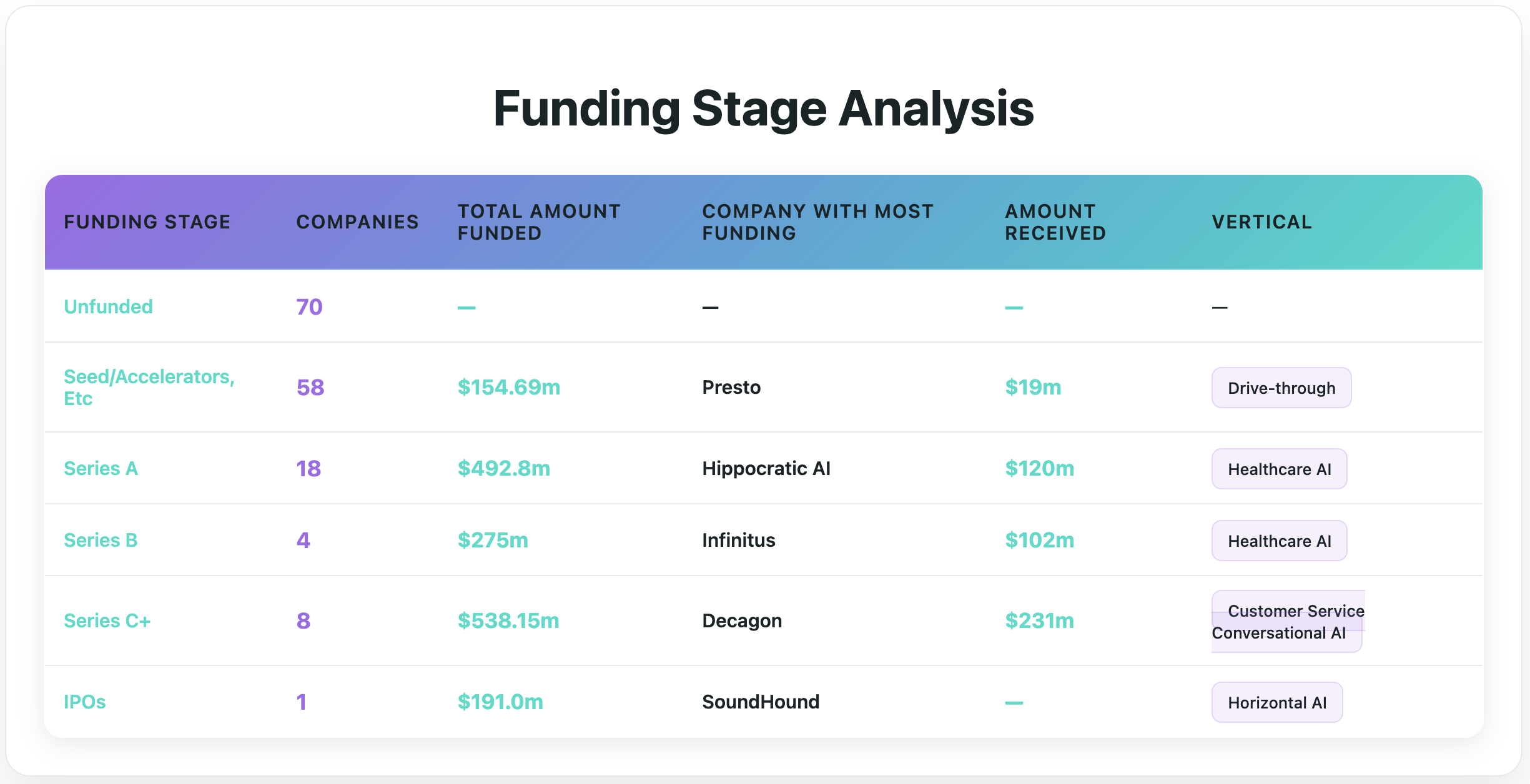
What’s interesting is the comparison between technical complexity and funding received. I did some desk-based analysis, looking at the delta between an assigned complexity figure (hard to do 100% accurately without the tech info, so this was based on use cases etc) and the funding received, and identified quite a few companies that, in my opinion, were probably overfunded based on the quality of their competitive offerings.
Especially when you take their offering out of their specific vertical and compare it more broadly across the wider industry, this indicates that many companies will likely fail to deliver on value or lose out to their competition unless they can leverage that investment to build something unique.
Time is of the essence for these companies, which need to scale fast and secure their technical moat rather than rely on vertical differentiation.
Should I trust a small AI company?
The main question is what you are asking them to do. Many of the companies on this list have straightforward use cases. If you want them to automate a specific piece of your business, like out-of-hours answering, they will do that, and it will likely be successful.
The main questions come if you are looking for more complex or robust deployments:
- A system that can export and share data with other systems
- A system capable of handling more advanced automations
- A system capable of being applied to more than the use case it was built for
These companies are selling point-solutions that will likely solve the issue they have been deployed to solve, but don’t think of them as ‘AI’ think of them as ‘An automated answering company’ and you’ll better understand their capabilities.
Thoughts on the broader landscape?
Following this review, we can divide the market up into some clear players.
- Small vertical-focused AI companies with low technical differentiation who will either:
- Build a strong customer base and survive/be acquired
- Be squeezed out of the market by broader players who also serve their use case at an economy of scale
- Vertically targeted players with strong differentiation
- Some of the smaller companies we reviewed did seem to be building on their vertical-specific needs with real technical and skills-based differentiation, especially in more difficult markets like Healthcare
- If these companies can build a strong technical and customer base, they may be acquired or carve out an industry niche
- Mid-sized Voice AI players
- Companies are building technical differentiation and establishing multiple vertical use cases
- These are the most likely candidates to grow as they are working on building a broad base of use cases and finding the places their technology applies across multiple customer types.
- Larger CX Innovators
- This category includes larger companies that have begun carving out CX expertise.
- A big point, though, is that many of these companies have already stepped beyond Voice AI and are now bridging into the broader CX industry, furnishing it with integrations and data powered by but not limited to Voice AI.
Conclusion
In this article we broke down the different types of Voice AI company that Cavell has witnessed in the market.
Many smaller startups are relying on fairly shallow vertical differentiation, which is not a guaranteed survival strategy. As horizontally focused players, and the CCaaS incumbents improve their vertically tuned solutions, expect any startup without proprietary technology or defensible IP to disappear rapidly.
The companies thriving and attracting the most funding are those building genuine technical differentiation: workflow orchestration engines, deep integrations, and strong data feedback loops. These capabilities create a moat that widens with each deployment and cannot be easily replicated by general-purpose models.
However, those startups are also at risk. Any of those with proprietary technology or IP may find themselves acquired fast by a market hungry for innovation or may find that proprietary approach quickly matched by the aggressive development schedules at the larger vendors.
My final impression is that the Voice AI startup boom is already past its peak. Over the next 24 months, expect a wave of consolidation, with horizontal platforms and CCaaS incumbents absorbing point solutions. The winners will be those with proprietary tech, deep integrations, and defensible data loop, the rest will be footnotes.
Join us next week as we dive into the implications of this growing new category of companies for the contact center industry.
Thanks for reading. This analysis is just one slice of Cavell’s CX intelligence. The 2025 CCaaS Market Evolution Report gives you the market forecasts, vendor insights, and strategic guidance you need to win in the Voice AI era globally and in 24 individual markets. Let’s talk! – Finbarr.begley@cavell.com