

 Back
to
all
Back
to
all
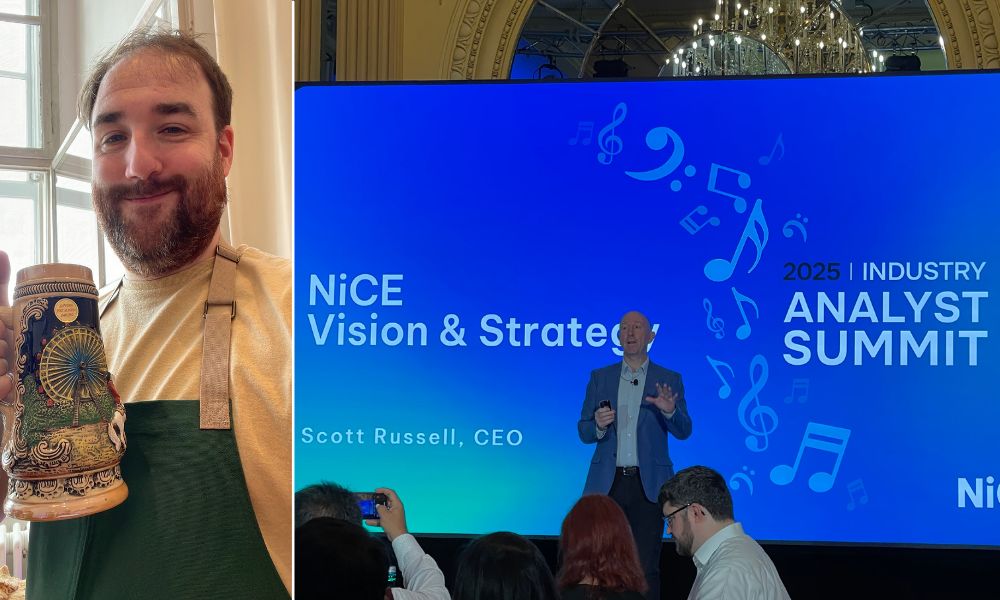
I think I can speak for the broader analyst community when I say that there was great excitement for this event. It comes hot on the heels of the (nearly $1 billion) Cognigy acquisition, as well as the recruitment of new President of CX, Jeff Comstock, and the first analyst summit with the new CEO Scott Russell. So, in many ways this was a new NiCE that was being put in front of us in Vienna this year, and I’d like to say the event didn’t disappoint.
Rather than announcing a wave of new features, NiCE used the summit to restate its identity and ambition. With Cognigy now in-house and leadership refreshed, the company is positioning itself not only as a contact centre vendor but also as the orchestration layer for the entire customer experience ecosystem. Russell’s message was consistent and deliberate: the era of “AI-First CX” has arrived, and it demands a re-architecture of how people, data, and automation interact across every channel.
Across three packed days, NiCE executives, partners, and customers painted a picture of a company determined to lead that transformation by anchoring its future in data unification, agentic AI, and enterprise-scale orchestration.
For analysts, it marked a clear inflexion point and we are curious whether it will succeed or not. NiCE is trying to move from defining itself as a CCaaS player, into a broader category of Customer Engagement Platform (CEP), and the broad ownership that sort of title entails.
The challenge in that approach is implicit; you have to earn the trust of the customer to move beyond your existing technology stack. Cognigy potentially buys that trust for NiCE, but there is a lot to still unpack from this event, so let’s get into it!
Scott Russell’s Message: “AI-First CX”
Scott Russell’s message was concise but emphatic: “Speed is a choice.” Not every decision needs to be rushed, but once a direction is chosen, execution must be immediate. It was a declaration of intent from a company that believes it has the scale, technology, and now the leadership alignment to move faster than its peers.
Russell’s vision of an “AI-First CX era” reframed customer experience as a system-wide reinvention rather than a product layer. He described AI not as an assistant for agents but as the connective tissue between people, processes, and data. Under this model, the contact centre becomes just one node in a broader web of automated, orchestrated customer interactions that stretch across sales, marketing, and service.
Several trends anchored his presentation:
- Agent AI will take over Tier 1 and 2 interactions, bringing about the “death of please hold”.
- AI orchestration will melt the organisational chart, allowing for the blurring of lines between departments as workflows become automated end-to-end.
- Human engagement won’t vanish but will be repositioned as a premium differentiator in high-value or emotional moments.
Crucially, Russell did not push NiCE as an all-encompassing platform (though this is an option for some customers). Instead, he acknowledged the company’s interdependence with partners like AWS, Salesforce, ServiceNow, and Snowflake. NiCE doesn’t intend to replace them; it intends to orchestrate across them.
This runs counter to the familiar narrative of “winners and losers,” or CRM and hyperscalers “eating the lunch” of CCaaS players that less-nuanced reports tend to push. What’s continuing is a web of integrations driven by customer demand. Consolidation will come, but these companies still bring distinct expertise that mandates interoperability and partnership rather than replacement.
From CCaaS to CEP: The Competitive Reframe
Perhaps the most consequential narrative shift at the summit was NiCE’s redefinition of what it means to be a contact centre platform. The company is no longer positioning itself purely within the CCaaS market; instead it’s expanding the frame to what it calls a Customer Engagement Platform (CEP). The concept builds on the idea that the customer journey no longer begins or ends in the contact centre, it also will shift to include sales, marketing and mid and back office workers. The only way to manage this integration without adding huge processes and more system bloat is to use AI as the unifying layer between every point of engagement, data source, and enterprise system.
In NiCE’s model, the CEP sits above traditional systems of record such as CRM, ERP, HR, and others, acting as the orchestration layer that ensures seamless continuity between them. It’s not just a hub for voice or digital interactions, but a platform that can ingest, interpret, and act on data from any system to deliver end-to-end resolution.
The implications are significant. The battle is shifting from who owns the agent desktop to who controls the flow of customer intent across systems. Genesys, Salesforce, and Microsoft are pursuing the same goal through different routes, and each brings advantages NiCE lacks Salesforce’s ownership of system-of-record data, Microsoft’s embedded enterprise footprint, and Genesys’s installed base in service automation. NiCE is placing its bets on interoperability, partnerships, and cross-system integration, coupled with the ability to deliver complex conversational automation through Cognigy’s agentic platform. It’s a pragmatic strategy one built on coexistence rather than conquest, and for now, it plays to NiCE’s natural strengths.
The Cognigy Inflection Point
We also got to hear about the integration of Cognigy into NiCE’s core platform narrative. While the deal has been covered extensively for its price tag, the real significance lies in what it enables technically and strategically. Cognigy brings with it one of the most mature agentic AI frameworks in the market (which was judged to be worth almost $1bn) and a platform capable of building multimodal, low-code virtual agents that can operate across voice and digital channels, integrate into enterprise systems, and perform end-to-end transactions.
Cognigy’s architecture allows AI agents not only to interpret intent but to choose and execute the right process or “tool” to fulfil that intent, blending deterministic and generative approaches. It’s a leap beyond simple intent trees or script-based bots, and one that makes NiCE’s automation story significantly more credible.
Customer case studies shared during the event ranging from Lufthansa Group and Sony PlayStation to Allianz illustrated that this isn’t theoretical. These deployments showed measurable containment, cross-language support, and full lifecycle automation across chat and voice. Each example demonstrated how agentic AI can handle the repetitive, structured work while still handing off seamlessly to human agents for higher-value or regulatory-sensitive interactions.
Strategically, Cognigy also strengthens NiCE’s ability to turn its massive interaction dataset into applied automation. Its platform can draw on the conversation intelligence, routing logic, and analytics that already sit within CXone, using that data to continuously train and refine automated journeys. This closes a loop that few competitors have yet achieved combining AI development, orchestration, and real-world performance feedback inside a single ecosystem.
The challenge now is execution: maintaining Cognigy’s agility while integrating it into NiCE’s enterprise-grade governance and data fabric without losing the speed that made it attractive in the first place.
It is also important to note that as part maintaining the value of this acquisition, NiCE has committed to making sure these capabilities remain available to Cognigy’s existing customers using other CCaaS platforms. NiCE will aim to differentiate itself in terms of integration depth and strategic alignment but for now there is no indication that these capabilities will stop being available to NiCE competitors.
Partner Ecosystem and Market Signals
One of the clearest themes emerging from Vienna was that NiCE now sees its partner ecosystem not as a support function but as a core strategic asset. The summit’s partner panel included leaders from AWS, Deloitte, Accenture, and Bell Integration was unusually candid about the state of AI deployment. The consensus was pragmatic: the technology is real, but so is the overhype. Success, they argued, depends less on model quality and more on disciplined implementation, outcome tracking, and change management.
AWS remains NiCE’s most visible cloud ally, underpinned by a multi-year strategic partnership that deepens integration across infrastructure, AI tooling, and marketplace routes to market. That collaboration was repeatedly framed as customer-driven rather than purely commercial, instead highlighting joint deployments for large, regulated customers where AWS, NiCE, and sometimes even Connect coexist to deliver sovereign or hybrid solutions.
Beyond hyperscalers, the tone from GSIs and integration partners was that NiCE is evolving from “tool provider” to ecosystem orchestrator. Partners are increasingly being drawn into solution design earlier, co-developing industry-specific use cases and governance frameworks rather than just implementing pre-packaged products.
The signal to the market is clear: NiCE understands that in a crowded AI-CX landscape, execution through partnership is more defensible than competing head-on with larger ecosystems. The open question is whether that collaborative posture can scale globally without diluting the control and consistency that enterprise buyers expect.
Customer Stories Grounding the Vision
While NiCE’s strategy sessions painted an ambitious picture of AI-first orchestration, it was the customer panels that grounded those ideas. What stood out across every story was not scale or novelty, but partnership under pressure, how NiCE’s responsiveness and integration capabilities translated into tangible outcomes.
At 211LA, a long-standing NiCE CXone customer supporting vulnerable communities in California, the discussion centred on how flexible automation and rapid reconfiguration helped sustain critical services during periods of extreme demand. It was a case study in agility and trust, NiCE supporting continuity when it mattered most.
At Fulton Bank, the focus was on practical AI adoption rather than wholesale transformation. Post-interaction summarisation and workflow optimisation have already cut manual workloads significantly, with voice automation next on the roadmap. The lesson: incremental deployment beats headline disruption.
And in the UK, the Department for Work and Pensions (DWP) programme, delivered with NiCE partner Route101 illustrated how CX transformation at national scale requires both global capability and local sovereignty. The collaboration highlights NiCE’s ability to balance compliance, pace, and modernisation in highly regulated environments.
Each of these cases reinforces the same message that Cavell has heard from its service provider partners for the last year. That the path to “AI-first CX” begins with trusted execution, not marketing theatre. That the competitive development of the latest AI technology, is important, but customers are still currently focused on understanding how it will impact them. And that overall the industry is starting to come to terms with what AI means for it, at every level, but the answers are far from certain.
Closing Analysis
By the end of the summit, one thing was unmistakable: NiCE is no longer framing itself as a CCaaS vendor in a crowded market but as the architect of orchestration in the AI-first CX landscape. Its strategy is not to own every system or replace established CRMs and productivity suites, but to sit between them coordinating data, decisions, and dialogue.
That positioning feels pragmatic and necessary. Enterprises are no longer choosing between all-in-one suites; they’re assembling ecosystems. NiCE’s success will depend on whether it can make those ecosystems work together at scale by balancing openness with control, agility with governance, and automation with human oversight.
The Cognigy acquisition gives it a real technical foundation for that vision. But the harder work begins now: integrating that agility into NiCE’s enterprise architecture without slowing it down, proving interoperability delivers measurable outcomes, and ensuring that orchestration doesn’t become another word for complexity.
CEO Scott Russell closed the event by saying NiCE will only be satisfied “when every customer intent is fulfilled.” That ambition captures both the promise and the pressure of the AI-first era. If NiCE can align execution to that goal which is delivering AI that resolves, not just responds it will set the benchmark for how contact-centre providers evolve into full customer-engagement platforms, but it’s not alone in chasing that goal, and execution, not vision, will decide who gets there first.