
Upcoming Event: Cavell CX Summit
Insights
4 min read
30th Jun, 2025
Is there any space left in the UCaaS market?

Recent announcements from some of the largest providers in this market have started to give some insight to how the UCaaS market is developing and how these providers are gaining significant scale in the market. The cloud communications industry has expanded rapidly over the past few years and growth has been enhanced by the pandemic as more businesses look to adopt cloud services and move away from on-premises deployments. The recent performance of Avaya (20% revenue drop and net loss of $1.4b) highlights the struggles that some of the legacy PBX manufacturers have faced by not successfully transforming their businesses to become cloud-first vendors.


One of the big questions that we get asked often is whether there are still opportunities for smaller or niche providers in the future or whether this will be all migrating to these larger provider. What we show throughout this article how much share do these providers have and how much of the global market there is left to migrate. We still see a huge opportunity for service providers to be successful in the market, either working with these providers listed or with their own solutions but scale and differentiation become more important as the market matures
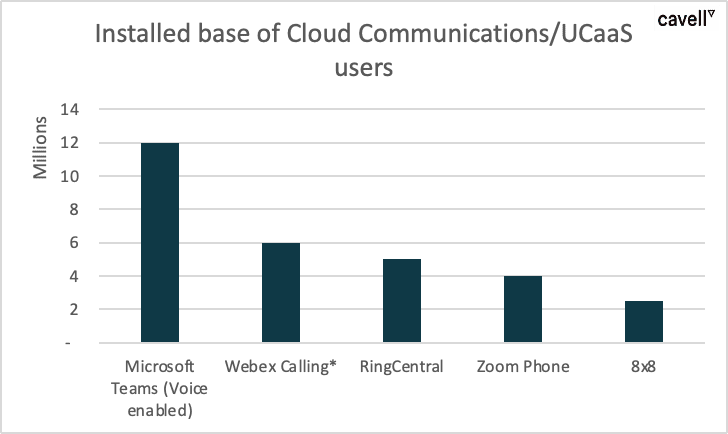

Five providers account for a global user base of 29.5m users

The graph below shows the providers who commonly are, as per our latest cloud comms reports, highlighted by service providers globally as their key competitive threat in the future and have been instrumental in much of the growth over the past few years.

*Not including other Cisco Cloud Calling products (BroadWorks, HCS etc) – Cisco’s entire cloud calling base is over 45m users


Although the numbers attributed to each provider look like they control the whole market, the vast majority of the 29.5m users have been delivered by partners. These partners range from tier one operators down to small agents who are all taking advantage of the suite of services offered by these providers. There is an ongoing battle in the channel for dominance as all of these providers and the wide range of other vendors are trying to gain market share within the channel as well as in the end customer.


The battle for the service provider community has been heating up recently with many telcos looking at how they can build partnerships, examining their ongoing business models, and looking for class-leading solutions to take to market. With many geographic markets expanding rapidly, telcos are looking at how they can bring best in class services to market and differentiate from their competition.

Out of a total global available market of 467m users, 392m (82%) have not moved to a cloud comms solution yet

Cavell’s latest market research shows that there is a total available market of around 467m users, of which the majority have still not moved to a cloud communications solution. Cavell puts cloud comms (UCaaS) penetration currently at just over 18%, indicating that there is still a huge global market left to migrate to the cloud with over

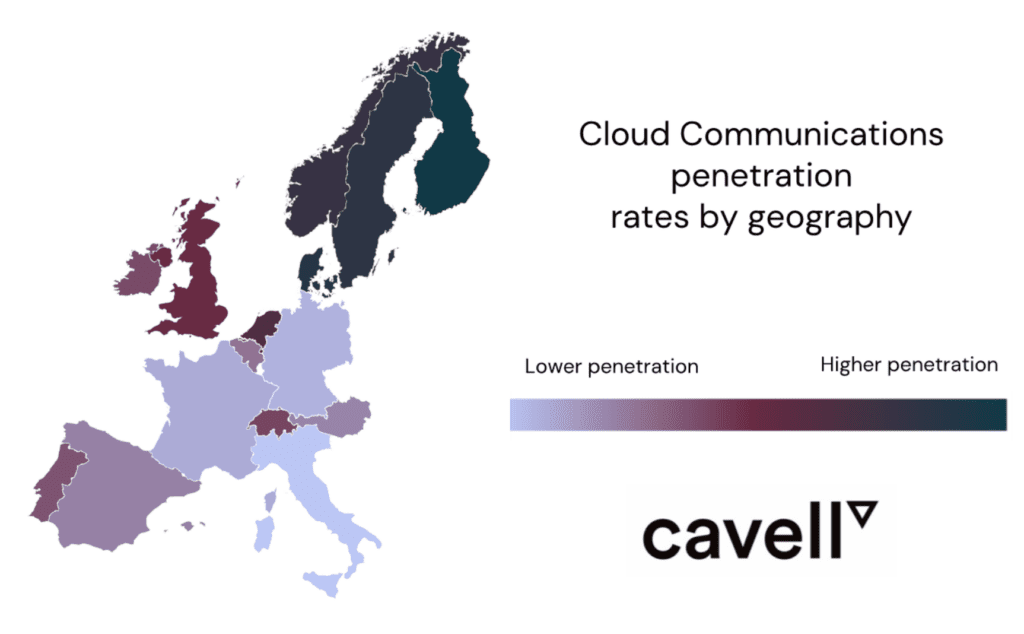
The penetration of cloud into the total available market changes by geography, with regions like the Nordics displaying a much higher penetration rate. Even markets such as Germany and France are still relatively underdeveloped with many providers looking to expand into these markets organically, via acquisition, or through building partner bases.  The US market has the largest installed based of UCaaS users globally with over 39m users and by far the largest number of service providers operating in the market. When looking at some developing markets, we see a much bigger opportunity around mobile UCaaS and foresee a huge opportunity in coming years.


Our forecasts show that penetration rates will rapidly increase over the next five years as more business move their communications to the cloud, representing a huge opportunity not only for the providers listed, but also for the rest of the market.

How have some of the providers grown so fast?

One of the reasons why these providers have been able to get so much scale is that they have been able to execute in multiple markets, whereas many of the other providers we track only operate in one market. Each of the providers has been able to execute at scale and target multiple customer sizes in the market whilst bringing new services to complement their existing product base.


Microsoft Teams


Microsoft Teams has been one of the growth engines since the pandemic hit, as many businesses adopted Teams to help enable remote working. From its most recent earning release Microsoft have now enabled over 12 million voice-enabled users on their platform. Cavell’s Microsoft analyst, Patrick Watson recently penned a blog post on how service providers are enabling voice within Teams which splits out the options available.

Blog-open
Article by
Continue reading
banner-image
Have a Question for Cavell?