Commercial models and enterprise requirements key for service providers – Catie de Marcillac’s thoughts from Cavell Enable
Enable was unsurprisingly heavily centred around Microsoft Teams and the opportunity for providers to add value to the Teams stack as traditional margins and revenue streams come under increasing pressure. Patrick Watson’s opening keynote centred around the telephony marketplace which encompasses integrations into collaboration platforms and third-party systems. Currently, 75% of end-users with a collaboration solution integrate into a productivity tool such as Microsoft 365 and G Suite, and 53% also integrate into another communication system such as telephony, mobile and contact centre. This integral link between collaboration, telephony and contact centre leads to a wider opportunity for providers to offer wider CX services outside of traditional telephony offerings.
As revenue generation remains the real contentious issue for providers, value-adds will act as a fundamental approach for providers to maintain relevance, with companies such as Akixi, Tollring, and AudioCodes all having developed advanced solutions to compliment collaboration platforms. Contact centres, other customer experience services, and CRMs will inevitably also play a role in this game as the industry converges and standalone telephony solutions become too basic for enterprises. Indeed, at the event, 42% of the audience members reported that Contact Centre provides the best opportunity for revenue generation in conjunction with collaboration telephony, showing the strong opportunity in the convergence between UC and CC.
This story was very much echoed by representatives from legal firm Norton Rose Fulbright, national standards body BSI and engineering company AtkinsRéalis, who all gave their insights into using Microsoft Teams within their organisations in Tom Arbuthnot’s panel. The session provided perspective for providers and telcos in the audience, as often the actual usage of collaboration at the enterprise-level can be underexplored at industry events which normally focus heavily on the vendor and provider narrative.
All three enterprises used Microsoft Teams Phone as part of the wider Microsoft 365 estate, making the platform a crucial ‘one-stop-shop’ for users and showing the importance of integrated platforms and multi-service offerings for enterprises to avoid siloed, separate technology stacks.
However, there were several challenges highlighted with the Teams Phone and collaboration experience, particularly due to the constant updates and new feature to the platform which makes it hard for enterprises to keep on top of, requiring constant end user retraining and management. The release of Copilot has also caused some disruption for enterprises due to its price point being a barrier for even these larger companies to invest in for every user. Ally Ward from Norton Rose highlighted that she had been trialling Copilot already and its major benefit was in file finding, but not so much for its content creation abilities which – according to her – have a way to go. While these pain points cause issues for enterprises, they also provide providers with an opportunity to deliver a much-needed value-add to their portfolios by offering more advisory services for businesses to help improve their usage of Teams and the wider 365 stack, including training organisations on how to utilise Copilot effectively and keeping them up to date on the latest software updates and innovations.
It’s also clear that enterprises are re-examining their employees’ usage and experience of Teams and rationalising their portfolios as a result. Damian Lewis from BSI highlighted that there are many users in the organisation that don’t need a phone number assigned to them, and Matt Ellis from AtkinsRéales also detailed that some workers in his organisation were looking at moving away from an E5 license to an E3 license as they didn’t need all the bells and whistles that E5 provides. This is a trend that Cavell have been closely monitoring in recent years and we are forecasting that as collaboration becomes more and more popular, the telephony available market will reduce slightly as more and more business move to collaboration-only solutions with no need for a PBX.
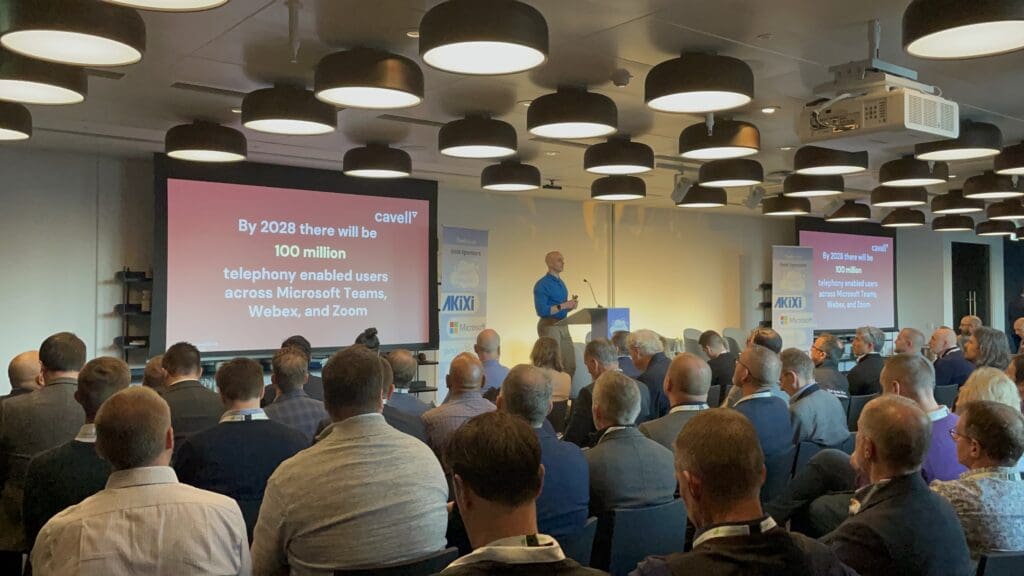
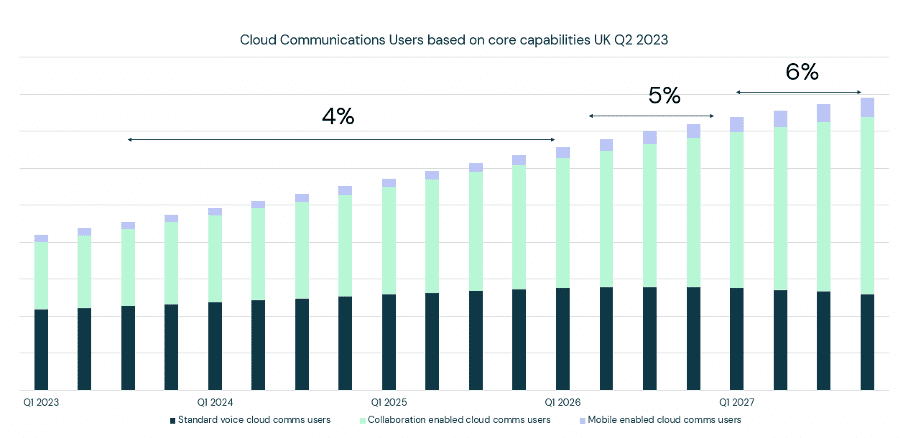
Despite this, Cavell are still forecasting major growth in telephony-enabled users between now and 2028. This shows that service providers and users are still taking a multi-vendor approach, a point which was reiterated in the Telephony in Collaboration panel moderated by Dom Black with Roy Dehing from Microsoft, Jason Gilligan from Zoom, and Marcel Kardol from Cisco. While it’s clear that Microsoft is currently leading the market, there is still plenty of opportunity for a multi-platform approach, with most service providers and telcos offering more than one solution for customers. This was shown most distinctly by the survey results from the panel, where 47% of the Enable audience said they offered telephony across 1 or 2 platforms, but 38% said they offered telephone across as many platforms as possible.




 Back
to
all
Back
to
all