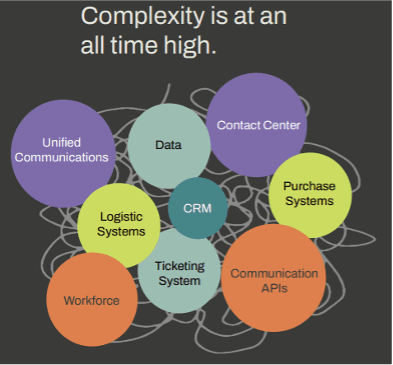
This can be partially achieved in a number of ways: with a more vertical focus, so they can go deeper into specific areas and create replicable examples and use cases; and focusing more on pay-as-you-go for anything, including ecosystem items. This way, customers and partners can build up their own solutions to meet their unique customisable requirements.
The question is, how scalable is this? There was still some uncertainty about how this flexibility would work from an SKU, bundling, and commercial perspective. 8×8 will need to find these answers to help customers and partners achieve the critical outcomes.
One of the key themes that emerged from this year’s summit was the need for good routes to market. All of 8×8’s testimonial customers who were present at this year’s event voiced their requirement for additional support and services from 8×8. 8×8 can’t deliver this at scale, to all of its customers globally. It, like many international technology providers, needs to expand its network of channels and delivery partners.
The type of partner is less important when it comes to traditional definitions, whether it be a communications service provider, reseller, or managed service provider. Managing Director of EMEA, Jamie Snaddon, hosted a partner panel on day two of the summit exploring partnership with 8×8.
The partner panel with Wavenet, Croft, and Digital Space Wholesale discussed how competitive the market is for 8×8 to attract partners and stand out as a vendor because of factors like pricing, marketing help, and exclusivity all present challenges. All three partners mentioned that trust, access, and support are the main reasons they chose to work with 8×8.
Customers need further support and that was made clear during 8×8’s event and has been clear in other vendor summits. Professional, value-added, and managed services – covering user support, change management, optimisation, and future ideation – are all areas where partners can help. As technology vendors can’t replicate this at scale across the globe, a channel-focused GTM is critical.
Cavell’s Channel Insights looks at the channel globally. In the UK, as an example, Cavell tracks nearly 7,000 channel providers, of which 73% advertise UCaaS but only 34% offer CCaaS. This presents a challenge for converged UC and CC providers like 8×8. There are a range of vendors: Zoom, RingCentral, and Dialpad, who are all targeting a limited number of truly capable channel partners. Who will win, and why? Commission structures, SLAs, technical, and sales support are going to be the key factors that help make the difference for these vendors.
GTM and the channel appear to be the key battlegrounds for communications vendors. Those who succeed in choosing, attracting, and optimising their delivery partner networks will grow most over the coming years.
No vendor can do this in isolation. Microsoft and Cisco have seen the greatest success by establishing strong partner networks. Although it is not looking to emulate those networks, 8×8 is betting heavily on its channel, and this is a key aspect of its overall transformation. Wilson also outlined that 8×8 will be more aggressive against its competitors on the UC and CC sides by going on the offensive, both in terms of pricing and partnerships. More news and details will follow.




 Back
to
all
Back
to
all