

 Back
to
all
Back
to
all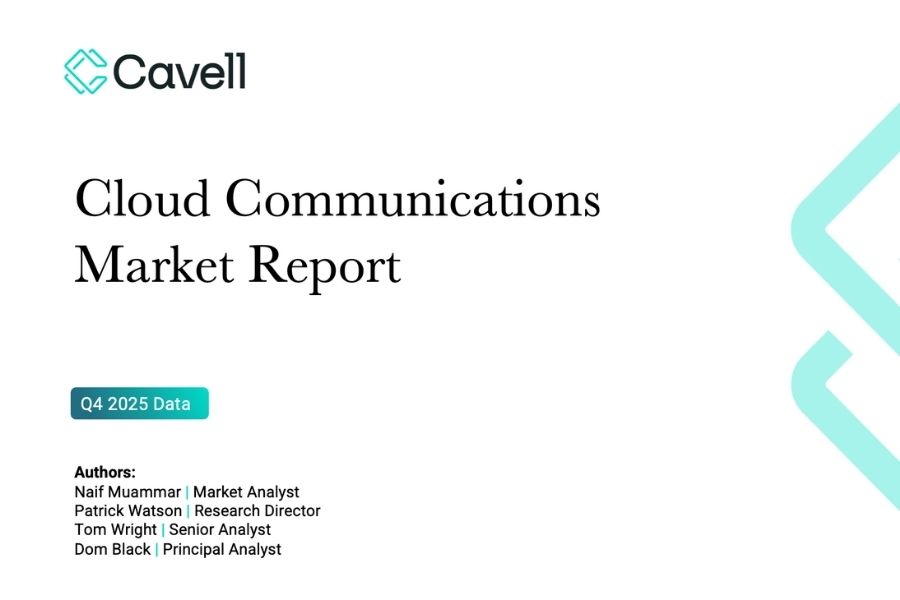
Cavell has published the latest Cloud Communications Market Reports covering six key markets: the US, the UK, Germany, France, Spain and the Netherlands.
Here are some of the key findings across all six reports.
1. Six markets at differing maturity
The markets covered in this report span almost every stage of the cloud communications adoption curve, from late-majority saturation to early-growth expansion, and that divergence shapes almost every other finding.
The US is the most mature of the six, with penetration at more than two-thirds and growth in single-digit percentages. The market has entered its late-majority phase, and double-digit growth is firmly behind it.
The Netherlands sits alongside the US as a highly penetrated market, firmly in late-stage adoption and therefore facing similar constraints on long-term net new user growth.
The UK is slightly behind these two markets, with over 10 million cloud comms users. Its growth still outpaces the US, but provider feedback collected through H1 and H2 2025 was consistent: conditions are broadly flat, deal velocity is slow, and organisations are extending the life of on-premises or hybrid deployments rather than committing to full migration.
Germany, by contrast, remains one of the most compelling growth destinations in European cloud communications. With penetration at around a quarter, the market expanded by nearly a fifth in 2025 and retains far more runway than any of the other markets covered.
2. AI Agents are the top strategic priority; execution remains the challenge
Cavell’s Q4 2025 service provider survey placed AI agents in the top-right quadrant of product importance across all markets, rated highest on both current and future strategic significance, with no other category coming close on the future importance axis.
The dominant commercial model is shifting away from per-user licensing towards consumption-based and professional services pricing. In the US, many providers are bundling basic AI capabilities into existing tiers at no additional cost near term, treating AI as a retention and differentiation tool while capturing margin through consultancy and implementation.
Some providers described the cost of matching hyperscaler development pace as “simply impossible”, while others warned that many AI start-ups will go bankrupt, leaving partners stranded.
Across all markets, a pragmatic architectural response is emerging: the “Bring Your Own AI” (BYOAI) / LLM-agnostic orchestration model. Rather than building proprietary LLMs, providers are positioning themselves as AI orchestration hubs, supplying call routing, transcription, and meeting summary layers, while allowing enterprises to plug in their preferred LLM. In the UK, just under half of enterprise customers say they will turn to their existing communications provider first for AI services, giving incumbents a meaningful first-mover advantage.
3. Sovereignty has become a commercial differentiator
Data sovereignty has moved from legal teams into procurement decisions across all markets, though the intensity and framing differ considerably.
France leads the sovereignty story in this report, driven by public sector procurement rules, the US Cloud Act, and growing enterprise sensitivity around data residency. The French government’s decision to move state users away from Microsoft Teams and non-European platforms has become a defining market signal, redirecting demand towards European and locally hosted platforms and making compliance an increasingly determinative factor in which providers can compete.
The US shows the least sovereignty pressure of the six markets, though AI-related data sensitivity and evolving compliance requirements are making data residency an increasingly active consideration, particularly for regulated industries and government-adjacent customers.
4. Microsoft’s trajectory has been revised across every market
Provider feedback and internal modelling have prompted Cavell to moderate its assumptions about Microsoft‘s growth trajectory, though the revision is sharpest where sovereignty concerns are most acute.
France is the most extreme case. The French government’s decision to move state users away from Microsoft Teams has materially altered the platform’s growth outlook in the public sector. Direct Routing remains the dominant deployment model; Teams Phone Mobile is not live in the French market. Sovereignty, regulatory sensitivity, and hybrid deployment preferences are expected to persist, further constraining Microsoft’s reach.
In the UK, prior assumptions were regarded as too aggressive on Microsoft growth and too pessimistic on Cisco‘s longevity. Microsoft should still grow, but more slowly than previously forecast. Cisco is expected to retain more market share than earlier models assumed.
5. PSTN migration creates near-term urgency in several markets
Legacy network switch-off programmes are generating commercial forcing functions in multiple markets, though the timelines and mechanisms differ.
In the UK, with 31 January 2027 confirmed as Openreach‘s hard PSTN cut-off date and over 500,000 business premises still on legacy lines, the window is narrowing fast. Openreach has structured a staircase of Wholesale Line Rental price increases: +20% in April 2026, +40% in July, +40% in October, cumulatively doubling the current £10.65/month charge. The complexity of migrating connected devices (payment terminals, fire alarms, CCTV, lift lines) means standard cloud migration approaches are insufficient for a material portion of this base.
In France, the 2030 ISDN switch-off deadline is the primary near-term accelerant, and is cited as a key driver of the 21.6% growth forecast for the 250+ employee segment in 2026. Large enterprises facing hard infrastructure deadlines are bringing forward migration decisions that might otherwise have been deferred.
In the US, the smallest businesses (0–9 employees) are delivering the highest percentage growth at 8.8%, driven in part by PSTN switch-off activity. The same dynamic of legacy inertia breaking down under pricing pressure is visible, though without a single hard deadline equivalent to Openreach’s cut-off.
Germany and Spain do not face equivalent near-term PSTN forcing functions, though the broader shift away from on-premises telephony, driven by SaaS integration requirements, AI demand, and commercial pressure, serves a similar structural purpose in both markets.