

 Back
to
all
Back
to
all

When I attended the first in-person WebexOne event in Anaheim three years ago, it felt very much like a Webex event – almost as if Webex was a separate company, not a part of Cisco.
Over the past three years, that tone has changed dramatically – with Webex now feeling like a core pillar of Cisco’s strategy.
This is, of course, by design, with Cisco moving over the last few years to break down the siloes across its huge portfolio – demonstrated by Jeetu Patel’s move from leading the collaboration business to now sitting across the whole business as President and Chief Product Officer.
The power of Cisco’s complete portfolio underpinned the whole of WebexOne in San Diego this year, even as Webex took centre stage.
Jeetu Patel said in no uncertain terms that Cisco has turned its operational culture on its head this decade.
“For the longest time, we operated like a holding company,” he said. “We had done a couple of hundred acquisitions and people thought they had to be a GM and own their own fiefdom, have their own marketing, have their own sales…
“What we’ve done is we’ve blown up that model. Anyone who thinks their path to progress is to down their own fiefdom is going to be sorely disappointed.
“We’re going to make sure that the integrated platform trumps individual capabilities of individual products
“So our breadth, which had become our liability, should actually be one of our most treasured assets.
This theme trickled down from the top of every session, with collaboration one of three pillars, alongside networking and security (albeit phrased differently; see below).
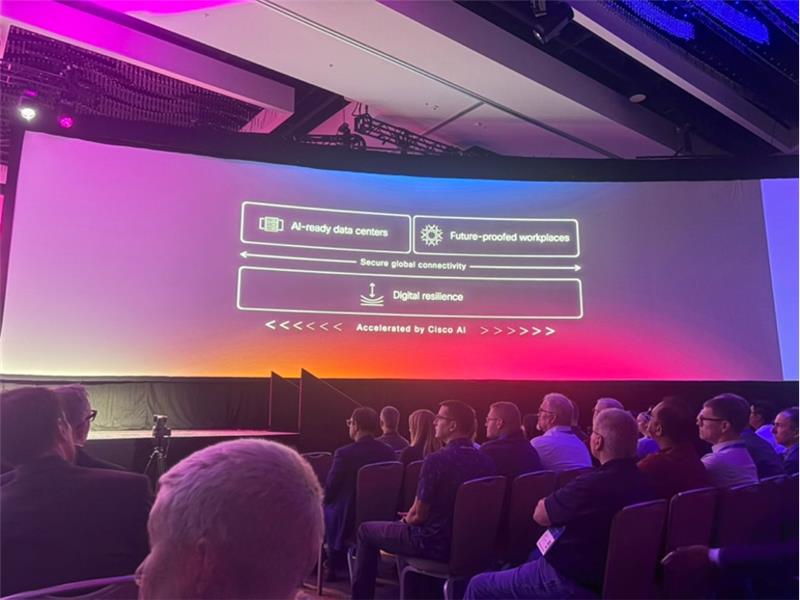
The rule of three was actually utilised several times across the event, to demonstrate Cisco’s approach to both AI and collaboration.
Perhaps the most interesting was how Cisco sees collaboration in the workplace (below)
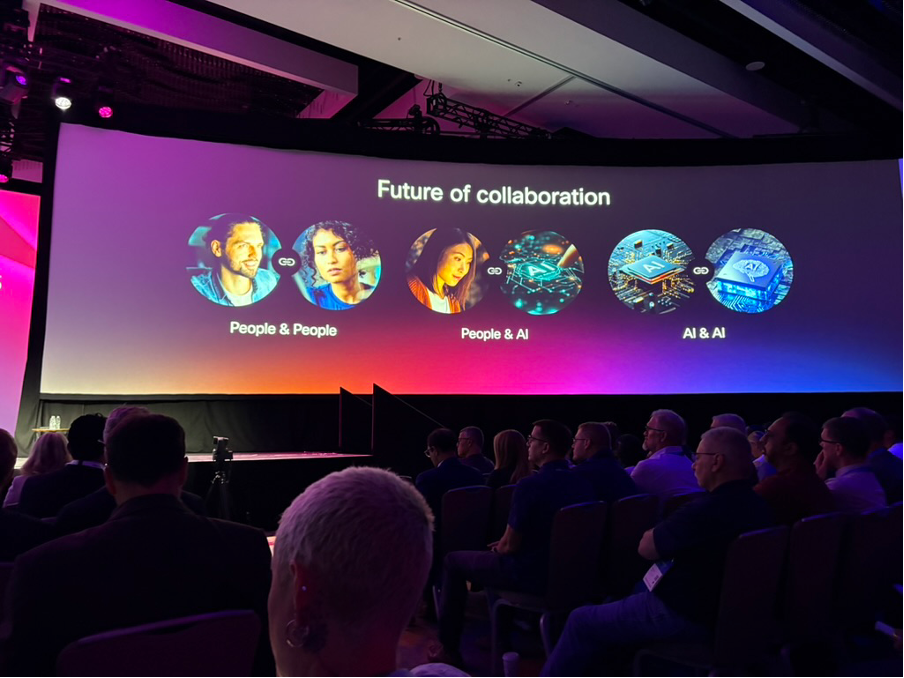
A misreading of this could leave one thinking that time progresses as we move to the right (people-to-people collaboration is over; we’re in the age of people-to-AI collaboration now; and, in the future, humans will be displaced by AI entirely).
Thankfully, that isn’t what Cisco is saying; instead, it’s preparing for a workplace where all three types of interactions will be required.
In his opening keynote, Jeetu Patel said AI has the potential to make a planet of eight billion people feel like 80 billion. This is only possible if AI agents handle a huge amount of tasks autonomously, which is why agent-to-agent collaboration will become essential.
Cisco’s approach to AI in Webex
Cisco’s leadership team is being incredibly careful not to throw AI at people and hope they understand what it means, what it does, and what it has the potential to do.
Snorre Kjesbu, Senior Vice President & General Manager of Collaboration, Employee Experience Technology at Cisco, said some competitors are throwing their AI products into a stew, leaving enterprises to work out what’s what. Cisco is trying to take a different approach with distinct products.
Among many announcements was the launch of five new agents. These capabilities are not necessarily new technology; similar products could probably be made by spending a few hours in Copilot Studio. However, they’re packaged in a way that makes it easy for customers to digest them.
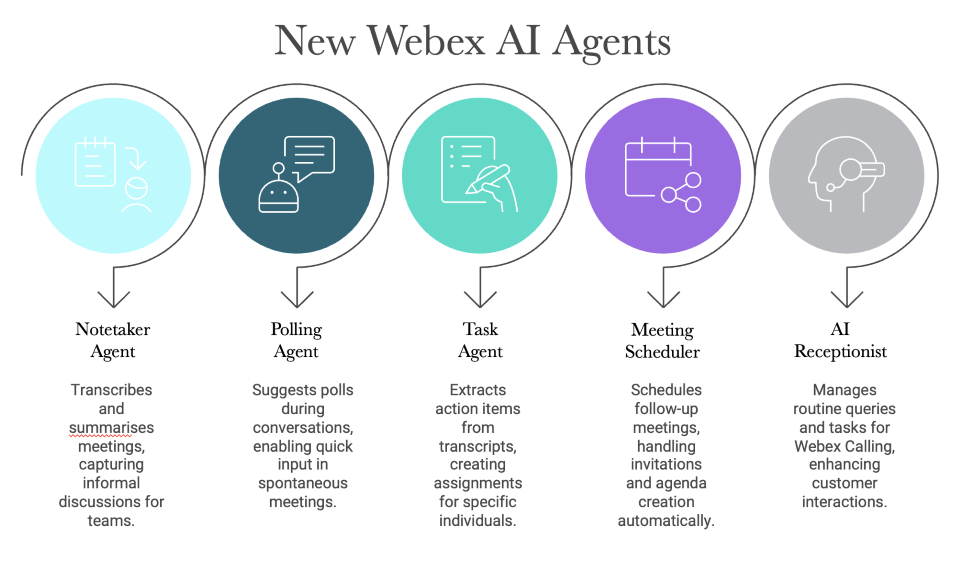
The Notetaker Agent transcribes and summarises in-person meetings as they happen, capturing impromptu huddles and brainstorms. It runs on the Webex App and Cisco Collaboration Devices with RoomOS 26, helping teams document informal discussions.
The Polling Agent listens to conversations and suggests polls when it detects a decision point. This takes Slido’s polling beyond structured webinars into spontaneous meetings where teams need quick input.
The Task Agent pulls action items from meeting transcripts and puts them in one place. Instead of leaving tasks buried in summaries, it creates assignments for specific people. Tasks will initially be stored in Webex’s own task manager, although support for third-party to-do apps may come down the line.
The Meeting Scheduler spots when follow-ups are needed, works out who should attend, checks calendars, writes an agenda, and books the meeting—no email tennis required.
The AI Receptionist for Webex Calling handles routine queries, answers questions and manages tasks like call transfers or appointments. Built on Cisco’s contact centre technology, it brings CX capabilities into Webex Suite for straightforward customer interactions.
Meeting Scheduler arrives Q4 2025, while Notetaker, Polling and Task Agents launch Q1 2026, when AI Receptionist begins controlled rollout.
The AI Receptionist is likely to be the only one of the five that is billed by consumption, with Cisco execs said that customers will buy $100 blocks of usage. It’s not entirely clear what much usage those blocks will provide, but this isn’t really Cisco’s fault – the pricing of LLMs changes frequently depending on which model and which version is used; sometimes the latest model can cost 10 times the amount of the previous, so buyers must expect pricing to be fluid.
Playing Nicely with Others
Cisco took great care to make sure WebexOne attendees know it wants to create an open system.
With Webex, this started with a Microsoft partnership a few years ago that sees Microsoft Teams run on Cisco devices for Teams Room. This has now extended to Zoom Rooms.
Beyond rooms, Cisco wants its Webex Suite to follow a similar path, most notably with its AI Assistant and agents for an agentic ecosystem.
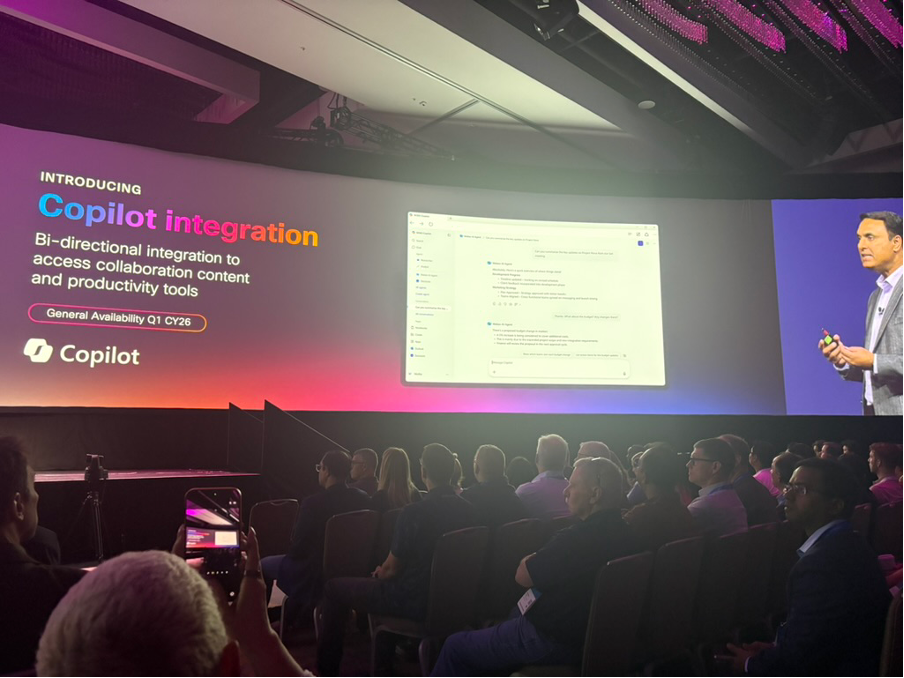
Cisco is connecting its AI Assistant with other enterprise platforms through agent-to-agent protocols and Model Context Protocol. The approach mimics what ChatGPT does for consumers—one interface across multiple services—adapted for enterprise workflows.
The Microsoft 365 Copilot integration works bidirectionally. Webex users can search SharePoint and OneDrive files through Cisco AI Assistant, whilst Copilot users can access Webex meeting summaries and conversation notes. This launches early next year.
Amazon Q brings semantic search and real-time indexing across enterprise data, designed to surface context-rich answers quickly.
For Jira and Salesforce, Cisco’s AI agents handle tasks like creating tickets or generating leads directly from the Webex App, reducing app-switching and preserving context across tools.
Availability: Amazon Q integration launches Q4 2025. Microsoft Copilot integration, along with the Jira and Salesforce agent capabilities arrive Q1 2026.
Webex Calling
Webex Calling certainly took a back seat while AI stole the show, but Cisco did still sneak in a few announcements towards the end of the event.
Cisco UCM still serves over 30 million users, according to the company. Cisco says it has delivered 125+ portfolio enhancements and 300+ security updates since version 15, with a roadmap extending through version 16.
At WebexOne, Cisco quietly launched Webex Calling Hybrid, which allows organisations to trunk Cisco UCM or other premises PBXs to Webex Calling, giving on-premises users access to AI services.
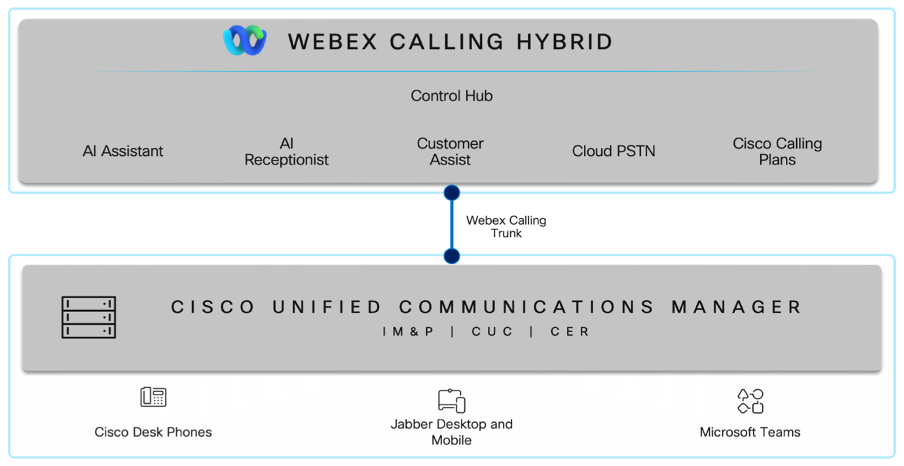
Cisco describes this as an “industry-first” approach that brings AI Receptionist, Webex Calling Customer Assist, Control Hub management, and cloud PSTN connectivity to UCM deployments.
Cisco positioned this as letting organisations adopt cloud features at their own pace whilst maintaining existing infrastructure. More cloud capabilities will extend to UCM customers over time.
This ties in with Cavell’s view of the market – particularly in some parts of Europe where there’s some hesitancy to move to a US cloud provider for geopolitical reasons.
Microsoft appears to be taking the brunt of this backlash, while Cisco has a compelling data sovereignty and residency story and, of course, a solid base of CUCM and BroadWorks customers.
Based on Cavell’s conversations with Cisco execs, the company, of course, wants to move on-prem and BroadWorks users to Webex – but the urgency has perhaps softened over the past 12 months.
It’s not yet clear how (if at all) Webex Calling Hybrid impacts the BroadWorks base, but we expect to see more AI features arrive for BroadWorks.
Elsewhere, Cisco is establishing dedicated datacentres in Mumbai and Chennai for Webex Calling. The company says this supports in-country storage of call recordings, voicemail, call detail records and audit logs to meet Indian regulatory requirements. Indian customers can connect via Local Gateway or Cloud Connect, supported by partners Airtel, Tata Communications, and Tata Teleservices Limited.
Customer Experience
Cisco opened the customer experience segment of the press and analyst conference by outlining the pace of innovation in its CCaaS platform (redesigned below).
The standout CX announcement was probably the AI Quality Management, which monitors the performance of both human and AI agents. AI QM can monitor things like an agent’s competency on a specific topic, whether an agent speaks too much or too little, and whether an AI agent consistently has call drop-offs at a certain point.
Launching in Q1 2026, the idea is for supervisors to have the ability to assess and coach their full workforce (human and AI) from one dashboard.
Supervisors benefit from AI-assisted scoring, real-time insights, personalized coaching for human agents, as well as actionable recommendations and performance optimization for AI agents—all natively in Webex Contact Center.
Supervisors get AI-powered scoring, real-time analytics, and tailored coaching for their human agents, alongside data-driven recommendations and performance tuning for AI agents, all embedded in the Webex Contact Center.
Elsewhere in the contact centre, Webex AI Agent for Contact Center is now generally available for cloud and on-premises customers. Cisco says beta support for more than 50 new languages arrives in Q4 2025.
Much like with Webex suite, Cisco company plans to add multi-agent collaboration in Q1 2026 using A2A and Model Context Protocol, letting Webex AI Agents interact with third-party agents and connect to external applications and data sources.
Cisco AI Assistant in Contact Center gains new features including suggested responses, real-time transcription, and mid-call and wrap-up summaries.
Cisco shared customer results: CarShield reports its Pre-Call Screening AI Agent handles 66% of calls without human intervention and cut onboarding time for powertrain claims by 90%. Columbia Bank says Topic Analytics revealed that roughly 20% of general enquiries concern loans requiring transfer to another department.
Webex Contact Center for Salesforce deepens integration through Salesforce’s Bring Your Own CCaaS programme. Interactions can be managed inside Salesforce via Service Cloud Voice and Bring Your Own Channel, powered by Webex AI and Agentforce. Currently in early access, with general availability planned for Q1 2026.
Amazon Lex integration lets AWS customers build virtual agents with AI receptionist capabilities for call deflection, routing, and caller intent recognition.
Epic Systems integration connects with Epic’s electronic health record software for care providers and contact centre agents.
Both of the above integrations are available now.
Cisco plans to launch Webex Contact Center in India during Q2 2026, with dedicated data centres in Mumbai and Chennai. The company says locally hosted solutions improve call quality, reduce latency, and meet compliance requirements for Indian and multinational organisations.
Cisco also announced plans to extend Webex Contact Center to Saudi Arabia, though no timeline was provided.
Security
Cisco says it will enable AI features for end-to-end encrypted (E2EE) meetings in Webex, though the company has not yet detailed how it plans to maintain end-to-end encryption whilst allowing cloud-based AI processing of meeting content.
Meeting platforms typically encrypt communications in transit, but E2EE has historically prevented the use of features like recording, transcription, and AI-generated summaries. This is because E2EE means only participants can decrypt the content—cloud services cannot access the data to process it for these features.
Cisco also announced partnerships with GetReal and Pindrop to add deepfake and synthetic media detection to Webex. The technology will identify manipulated content in real time and let meeting hosts respond immediately. General availability is planned for Q1 2026.