Security and portfolio breadth as its moat: Microsoft 365’s edge in enterprise communications
Microsoft does not run a dedicated Teams-focused event, and this has left a clear gap in the market, slightly surprisingly, given that Teams is now one of the world’s largest collaboration and communications platforms. The Microsoft 365 Community Conference plays an important role in filling that gap by giving Teams and the wider Microsoft 365 stack proper attention, rather than treating them as secondary topics. With more than 3,000 attendees joining the event in Orlando this year, the demand and scope for future growth is clear.
At Microsoft’s flagship Ignite event, the focus is still primarily on Azure, infrastructure and developer-led themes. While clearly essential, the attention on these themes limits capacity for deep discussion around Teams, workplace collaboration, and everyday customer use cases in Microsoft 365. This lack of focus has, until now, been addressed largely by third‑party and community-led events, including Cavell’s own Enable event – created specifically to give Teams and collaboration a dedicated forum. Against that backdrop, the Microsoft 365 Community conference provides a more central and credible focal point for roadmap discussion, validation, and practical ideation, grounded in how Teams and Microsoft 365 are actually being used and shaped in real organisations.
Naturally, the audience skewed heavily towards the Microsoft ecosystem, but what made the event interesting from a Cavell perspective was not the scale or the announcements. It was what the sessions revealed about how Microsoft is positioning itself as a platform layer for collaboration, communications, security and AI; and what that positioning implies for communication technology providers.
Microsoft’s real advantage in business communications does not come from Teams as a standalone product, but from its position inside the wider Microsoft 365 stack, where security, identity management, and compliance sit at the core. This means that communication is governed by the same controls that protect email, files, devices, and increasingly, AI agent workloads. For risk‑aware businesses (an increasing number, according to Cavell’s latest research), this integration matters more than siloed features.
Buying Teams is effectively buying into a security model that spans identity, data protection, compliance, and threat defence at a global scale. This makes Microsoft difficult to compete with in communications, not because it necessarily leads on voice or collaboration innovation, but because security, trust, and control increasingly shape enterprise buying decisions. In that context, security acts as the moat that protects Microsoft’s position, basing Teams firmly in a fortress of a platform that competitors struggle to penetrate.
For vendors and partners building businesses around UCaaS, CCaaS, collaboration, and adjacent services, the event offered useful signals, although not always explicit, and not always comfortable. Some areas were treated as strategic foundations. Others felt increasingly subsumed by broader productivity and AI narratives. The underlying question was less about feature velocity, and more about where long‑term value, differentiation, and revenue will realistically sit as AI, and AI agents, become ubiquitous.
The most relevant themes for the communication providers in attendance are increasingly important when it comes to shaping their future Microsoft partnership strategies. Microsoft, as you would expect, feels genuinely strong in key areas, but emphasis is shifting, and unresolved tensions remain for vendors, integrators, and service providers operating in and around the Microsoft ecosystem.
Microsoft’s security capability and positioning
Security was the dominant theme of the conference, and for communication providers this matters more than it might first appear. Cavell’s business decision maker studies over recent years have seen security concerns rise up the rankings of strategic communication goals. Microsoft consistently framed security not as a supporting workload, but as the primary constraint and enabler for AI, collaboration, and communications at scale. From keynote sessions to deep technical breakouts, the message was clear: if trust fails, everything else becomes irrelevant.
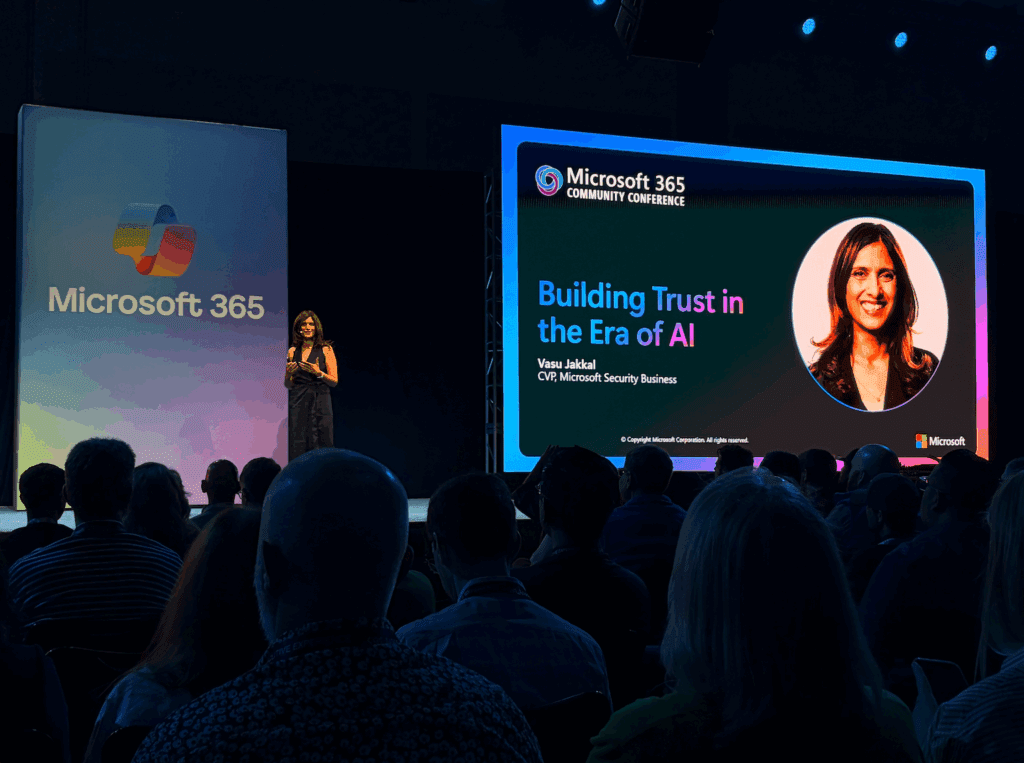
Vasu Jakkal (pictured, below), CVP of Microsoft Security, captured this in the day two keynote:
“It takes a long time to earn trust, but it can be lost in a second – trust starts with security and that’s why security is Microsoft’s number one priority.”
This was not positioned as a marketing message, but as an operational reality. As AI adoption accelerates, recovery speed, visibility, and governance are equally as important as advanced prevention.
Several speakers reinforced this point in practical terms.
At the forefront of Microsoft’s security strengths are its frontline cyber‑prevention capabilities, particularly through Microsoft Defender. Defender provides built‑in protection across endpoints, including real‑time antivirus, anti‑phishing, and anti‑malware controls across Windows and mobile devices. Delivered as part of Windows and Microsoft 365, it gives organisations a central view of threats, alongside controls for ransomware protection, web safety, and firewall management. Crucially, these protections sit alongside Teams and Microsoft 365 rather than outside them, meaning communications, data, and users are protected by default.
Beyond frontline prevention and detection, recovery and restoration form the next critical phase, with organisations increasingly focused on how quickly systems, data and communications can be restored when incidents do occur, rather than assuming breaches can always be prevented entirely. Data repositories and mailboxes can usually be recovered, but organisations cannot afford recovery to take weeks—an issue exacerbated by growing data volumes.
Another historical foundational challenge in security has been observability. Organisations have long struggled to gain a clear and consistent view of where data sits, how it moves, and who can access it across increasingly complex environments. That lack of visibility created blind spots that were often hidden by complexity rather than deliberate protection. Security by obscurity filled the gap, but it was never a durable strategy. As AI‑enabled attacks become more capable, automated and persistent, anything that can be discovered eventually will be. Exposed data, weak permissions, and poorly governed applications are surfaced faster and at greater scale than before. In this environment, visibility is no longer a supporting function but the core of effective security. As one session put it bluntly, “you cannot protect what you cannot see.” Modern security depends on understanding data in real time, classifying it correctly, and maintaining continuous insight so organisations can control risk and respond quickly as conditions change.
For communication technology providers, Microsoft’s strength here is not any single security product, but the breadth and depth of its stack. Identity through Entra, data classification and governance via Purview, threat protection in Defender, SIEM capabilities in Sentinel, and now security‑focused AI agents operating across these layers. The emphasis was on integration and visibility rather than point solutions.
Agent sprawl was repeatedly highlighted as a growing risk. Microsoft was explicit that many customers do not yet understand how many agents they are already running, who created them, what data they can access, or how they interact with other systems. With Microsoft itself reportedly operating over 500,000 internal agents, these concerns are no longer theoretical. The soon-to-be generally available Agent 365, positioned as a central management and visibility layer in the Microsoft 365 admin centre, is designed to give organisations and their partners a single view across agent inventory, risk, access, and governance.
Cavell’s research strongly supports this emphasis. Across regulated industries and larger enterprises, security, compliance, and data governance are the primary gating factors for AI adoption. Fear of disruption, regulatory exposure and reputational damage often outweigh potential productivity gains. In that context, Microsoft’s security‑first narrative is credible and resonates strongly with risk‑aware buyers.
At the same time, the discussions glossed over some practical challenges that many communication providers encounter daily. Data classification, permissions hygiene, and governance processes remain immature in a large proportion of customer environments. Particularly those in smaller organisations. Microsoft acknowledged that security is an ongoing journey rather than something that can be fixed in months, but the operational burden this places on customers, and by extension on partners, creates both opportunities and risks.
For smaller and mid-sized providers, there is an open question around how realistic this level of governance is in practice. The tooling may exist, but the skills, processes, and commercial models required to support it at scale remain challenging. This is something Cavell has looked to explore from the perspective of communication providers of all varieties in the first of its Impact Series of research reports. Microsoft’s security story is a clear strength, but one that implicitly assumes a level of operational maturity that many customers have yet to reach.
What ultimately strengthens Microsoft’s position is the power of the Microsoft 365 stack as a whole, rather than Teams in isolation. Teams sits natively inside a wider platform that spans identity, security, compliance, productivity and device management, all delivered through a single architecture. This full‑stack approach is difficult for competitors to replicate, particularly in enterprise environments where security, data protection, and risk management carry more weight than individual features. Microsoft’s depth in areas such as identity, threat protection, information governance and compliance increasingly shapes buying decisions, even for communications workloads. As a result, Teams is not just competing as a collaboration or communications tool, but as part of a broader enterprise platform where security and control are the primary points of differentiation.
The relative lack of focus on calling and telephony
Against the prominence of security and AI, calling and telephony felt noticeably less central. Teams Phone is no longer a primary focus, taking a backseat behind Copilot. Teams as a collaboration environment still framed much of the discussion, but Teams Phone and traditional voice workloads were positioned as part of a broader meetings and synchronous communications layer, rather than as a strategic pillar in their own right.
This was most evident in how Microsoft presented its core workloads. Copilot, agents, meetings, SharePoint, and the underlying data layer all sat ahead of calling in the conceptual stack. Voice appeared as one modality among many, rather than the anchor it once was. That shift aligns with usage patterns. Peer‑to‑peer Teams meetings now far outweigh fixed or mobile calls in many organisations.
However, for communication technology providers, this repositioning raises important questions. Is calling still a growth driver, or is it becoming table stakes? Necessary, but no longer differentiated? Microsoft did continue to frame voice as commercially important, particularly for small and mid‑sized customers. Investments in fundamentals such as multi‑line support, along with Copilot‑driven call delegation, suggest that core telephony is still evolving rather than being left to stagnate. There are more innovative new features to come in its development roadmap, but for now these sit under NDA.
There was also meaningful discussion around call queues and agent experiences. Here, Microsoft’s view of voice extends beyond call handling. Calls become entry points into broader workflows, identity verification, and automated decision flows built on the Power Platform. In this model, telephony is less about minutes and extensions, and more about how voice triggers and connects into wider business processes.
Cavell research broadly supports this trajectory. Buyers increasingly evaluate communications platforms based on integration into workflows, CRM systems and AI assistance, rather than voice capability in isolation. That said, voice remains sticky and commercially significant, particularly in regulated sectors, frontline environments, and customer service contexts.
What felt missing was a clearer articulation of how Microsoft intends to actively advance calling as a strategic workload, rather than allowing it to sit permanently in the shadow of Copilot and agents. Microsoft implicitly acknowledged that Teams and communications are no longer the “flavour of the month”. The open question for providers is whether communications will be pulled back into focus as AI matures, or whether it remains a supporting layer beneath the productivity and agent narrative.
For vendors and partners whose businesses are still heavily anchored in voice, this creates uncertainty. Calling is not disappearing, but its role, and its ability to drive differentiation, is clearly changing.
The challenge of educating customers and partners
One of the most valuable parts of the conference for communication providers came from customer voices rather than Microsoft speakers. The British Airways session was particularly instructive. BA outlined a large‑scale Copilot adoption programme underpinned by internal portals, feedback loops and a clear focus on maintaining a 90% adoption rate. The message was unambiguous. “The only way you get the value out of Copilot is if people adopt it.”
This theme of education extended well beyond end users. Multiple executive sessions acknowledged that partner enablement is just as critical, and possibly harder. The pace of AI development means that even experienced partners struggle to keep up. As one discussion highlighted, even advanced researchers do not fully understand how AI capability will evolve, let alone how it maps cleanly to repeatable business outcomes or commercial products.
This matters directly for communication technology providers. Many are being asked by customers to explain, deploy, and support AI‑driven capabilities that are still rapidly evolving. Lab studies may suggest productivity gains, but real‑world usage is far less predictable. Users apply AI to new and unexpected tasks, outcomes vary widely, and success is highly dependent on data quality, permissions, and organisational culture.
Cavell research consistently shows this gap. Many organisations now accept that AI is strategically important, but far fewer feel confident rolling it out beyond pilots. Providers and integrators are often expected to bridge this gap, yet they themselves need clearer guidance, repeatable designs, vertical and segment use cases and commercially viable service models to do so at scale.
Microsoft talked about such templates, industry‑specific patterns and analytics to track adoption and ROI. These are helpful building blocks. However, the practical challenge of educating millions of users and thousands of partners remains unresolved. For providers, education is becoming a core part of delivery, but one that is difficult to productise and even more difficult to monetise consistently.
A lingering question from the event is ownership. Who ultimately owns AI literacy inside customer organisations? IT, line of business leaders, partners or vendors? The importance of education and articulation of the ‘art of the possible’ was clear. Accountability was not.
Natural language development and design capabilities – and the implications for the partner model
Running beneath many sessions was a fundamental shift in how capability is created and accessed. Microsoft repeatedly demonstrated how conversational AI and natural language interfaces are reducing the barrier to development, design, and automation. Tasks that once required coding skills, specialist tools or long experience can increasingly be achieved by describing intent and allowing the system to suggest, refine, and build.
This was visible across Copilot Studio, SharePoint, Teams and Power Platform. Skills can be taught rather than configured. Lists can be queried and updated through chat. SharePoint is evolving into both a content and intelligence layer without users needing deep knowledge of its structure. All of this is built on data and tools that organisations already have.
For customers, this is empowering. Capability is being democratised and experimentation becomes easier. For communication technology providers, however, this introduces real tension. Many existing services models are built around designing, configuring, and optimising exactly these kinds of environments. If self‑service becomes easier and more capable, parts of that value chain are inevitably compressed.
Microsoft did not dismiss this tension, but nor did it resolve it. Partners were consistently positioned as essential, yet implicitly encouraged to move up the value stack. Less time spent on basic implementation. More emphasis on governance, security, outcome design, integration, and change management.
Cavell research suggests this transition is already underway, but uneven. Providers that remain heavily dependent on manual, labour‑intensive services are under pressure, whereas those that successfully reposition around advisory, optimisation, and vertical expertise are better aligned with where buyer value is shifting. However, there is an uncomfortable overlap period where old revenue models erode faster than new ones emerge and mature.
Trust adds another layer of complexity. As agents become more autonomous, and in some cases operate without a human, regulated organisations will be wary. Provider expertise in risk management, compliance, and assurance will become essential. Whether customers are willing to pay for that expertise is another question.
AI, Agents, and a shifting centre of gravity
The event showcased Microsoft’s move to position Copilot away from a single, OpenAI‑centric approach towards a more flexible multi‑model strategy, which is a positive step. It gives organisations greater choice over which models they use, based on risk, performance, and data considerations, rather than forcing a one‑size‑fits‑all solution.
In some cases, Microsoft can also guide customers towards the most appropriate model for a given task, or blend multiple models to achieve better outcomes. This approach fits well with Microsoft’s broader enterprise security and governance mindset, giving organisations more control as they adopt AI at scale.
For communication technology providers, the harder problem is commercial rather than technical: how to translate that capability into sustainable, differentiated services in a world where the platform itself is doing more of the work.
Viewed through the lens of communication technology providers, the Microsoft 365 Community Conference was less about announcements and more about signals. Security is foundational and increasingly non‑negotiable. AI and agents are rapidly reshaping how work gets done, especially in larger more technologically open organisations. Natural language is lowering barriers and challenging established services models.
Meanwhile, traditional communications workloads like calling are becoming more embedded, less visible, and harder to differentiate.
The event did not offer a full suite of answers, but it did sharpen the questions providers need to be asking. Where does defensible value sit as the platform becomes more capable? How do providers monetise education, governance, and trust? And how do communications businesses evolve when voice is no longer the centre of gravity? Those questions will matter far more than any individual roadmap detail over the next few years.




 Back
to
all
Back
to
all